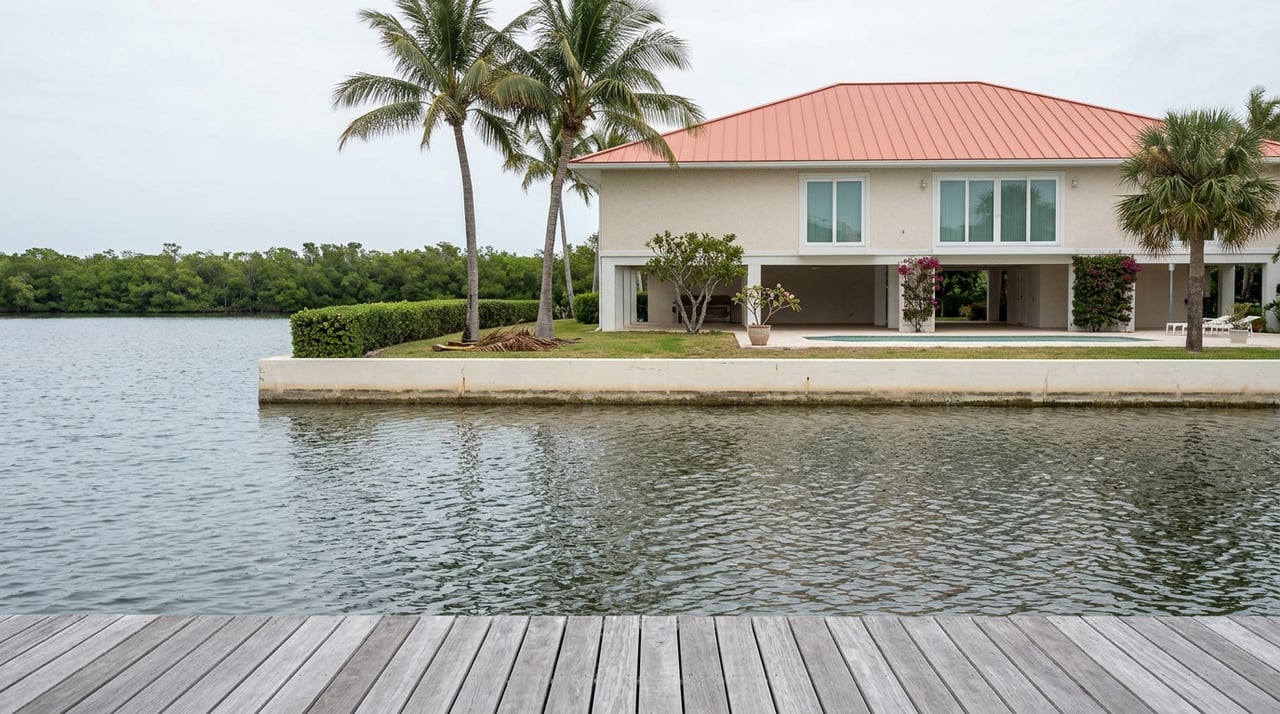
Thirty five lots on Shark Key have never had a house built on them. On an island with only seventy five building lots total, tucked behind a single gate at mile marker 11.3, that is not a rounding error. That is nearly half the island sitting empty on one of the most exclusive addresses in the Lower Keys, where finished homes routinely list between three and six million dollars.
The obvious read is opportunity. Half the lots are open, so half the island is still available to whoever wants to build a custom estate from scratch. The actual mechanism working against that read is Monroe County's own permitting math, and it treats the very feature that makes Shark Key valuable as a liability on paper.
The County Doesn't Score Water Views the Way Buyers Do
Every new home in unincorporated Monroe County needs a Rate of Growth Ordinance allocation before a building permit can be issued, whether the county calls it ROGO or the neighboring cities call it BPAS. The system exists because the Keys are designated an Area of Critical State Concern, and the state caps residential construction to a rate that keeps hurricane evacuation times inside a legal window. You can read the ordinance language directly through Monroe County's land development code, which lays out a competitive, points based scoring system rather than a first come, first served line.
That scoring system rewards land close to existing infrastructure and away from environmentally sensitive or high hazard zones. Lots sitting directly on open water, in what FEMA classifies as a VE flood zone, start well behind lots set back on higher ground, while land in the county's Tier III classification, generally set back from the water's edge, earns the highest marks in the same system.
Shark Key is a waterfront island built almost entirely around deep water dockage and open sightlines across the Gulf and Atlantic. The exact quality that makes a vacant lot here worth building on is the exact quality the county's own point sheet is designed to slow down.
What "Half Developed" Actually Signals
Not every vacant lot on Shark Key is stuck in the same way. Some parcels are ROGO exempt, meaning a structure once stood there and the right to build was already established years ago. Those lots trade on a different footing entirely, closer to a straightforward purchase than a permitting question. Other vacant parcels have never held a permit, which means a buyer who wants to build there is stepping into the same competitive allocation pool as everyone else on the island chain.
As of March 2024, Monroe County's own planning department put the unincorporated county's remaining market rate ROGO pool at roughly 154 permits, with another 144 held in reserve for administrative relief cases. That pool has not been meaningfully replenished since. County commissioners met on December 17, 2025, with the governor and cabinet sitting as the Administration Commission, and staff recommended earmarking a portion of the county's remaining allocations just to keep permits flowing through July 2027 while a larger release of new allocations, tied to a small extension in the county's hurricane evacuation clearance time, works its way through state review.
None of that touches a lot that already carries an allocation. It touches every vacant, never built parcel that doesn't.
A vacant lot on Shark Key with a prior structure and an existing allocation is a different asset than a vacant lot that has never been touched, even if the two sit side by side with identical water frontage.
For a buyer comparing two open parcels on the island, the water view tells you almost nothing about which one is actually buildable on a predictable timeline. The permitting history tells you everything.
The HOA Dues Are a Clue, Not an Oversight
Shark Key's homeowners association runs the gate, a clubhouse, tennis and pickleball courts, a private beach, and an inland swimming lagoon. Quarterly dues for that package sit in the low four figures, a number that reads almost modest next to the home prices it serves.
That gap is not the association falling short. It is the design working as intended. A larger resort style property, the kind with a staffed marina, restaurant, or spa, carries dues that scale with those services. Shark Key's amenity list is deliberately compact: a clubhouse, courts, a lagoon, a beach, and a gate managed through fobs and access codes rather than a full concierge staff. Lower shared infrastructure means lower shared cost, and it also means the community stays quieter and less trafficked than a larger development built to support more amenities and, by extension, more people moving through it.
Buyers weighing Shark Key against a larger gated community elsewhere in the Lower Keys are not just comparing home prices. They're comparing two different bets on what a gate is supposed to protect: privacy with a short amenity list, or a fuller resort experience with the higher carrying costs that come with it.
What to Ask Before You Fall for a Vacant Lot
If a vacant Shark Key parcel is on your list, the water view is the last thing to verify, not the first.
- Ask whether the lot carries an existing ROGO allocation or is ROGO exempt due to a prior structure, and get that confirmed in writing rather than taking a listing description at face value.
- Request the flood zone designation and, if one exists, the elevation certificate. Since 2022, flood insurance under the National Flood Insurance Program's Risk Rating 2.0 methodology prices premiums against the specific building rather than the flood zone alone, so two lots in the same VE zone can carry very different insurance costs once something is built.
- If no allocation exists, ask what tier and score the parcel would likely receive under the county's current point sheet, since VE zone frontage starts that application behind land set back from open water.
- Pull the HOA's current budget, reserve study, and architectural review guidelines before assuming dues will stay where they are today.
None of this is a reason to avoid Shark Key. It's a reason to treat the empty half of the island as a set of individual permitting questions rather than one open category of available land.
A Few Questions Buyers Ask First
If a lot has been vacant for years, does that mean it's easier to get a permit now? Not on its own. Time on the market says nothing about whether a parcel carries an allocation. A lot that has sat vacant for a decade without ever holding a building permit is still competing in the same scored pool as a lot listed last month.
How often do homes actually come up for sale on Shark Key? Turnover is limited by the island's small lot count. It is common for only a handful of homes to be listed at any given time, which is part of why comparable sales data on the island is thin compared to larger Lower Keys neighborhoods.
Does the FEMA flood zone on a lot ever change? It can. Flood maps are periodically updated, and a parcel's zone designation on file today is not guaranteed to be its designation permanently. The official elevation certificate process through FEMA is the tool for documenting a specific building's position relative to base flood elevation, and it's worth requesting fresh documentation rather than relying on an older certificate that predates recent map revisions.
Shark Key rewards buyers who ask about permitting history before they ask about square footage. If you're weighing a vacant lot, an existing estate, or how Shark Key compares to another gated Lower Keys community, the Karen Haack Team has spent decades working through exactly these questions with local buyers and sellers. Talk to a Lower Keys real estate expert today.